

By Paul Cheek, Senior Advisor, Entrepreneurship & AI, Martin Trust Center for MIT Entrepreneurship and Jeff Larsen, Assistant Vice-President, Innovation and Entrepreneurship, Dalhousie University
Why it Matters
Deep tech, medtech, and pharma ventures have always faced a decade-long gauntlet of massive capital demands and crushing scientific risk, limiting the pace of breakthroughs that could transform human health and sustainability. Now, AI is shattering these barriers—accelerating drug discovery, optimizing clinical trials, and simulating advanced materials—compressing innovation cycles and unlocking vastly more investment opportunities. By adopting an AI-Driven Enterprise model, founders and investors can turbocharge success rates and democratize deep innovation, turning the “impossible” mission of curing diseases and creating sustainable technologies into a fast-moving reality.
In a 2013 paper, MIT’s Bill Aulet and Fiona Murray highlighted the distinction between innovation-driven enterprises (IDEs) and small- and medium-sized enterprises (SMEs). Most SMEs are local or regional, and modestly scaled businesses with low capital and headcount requirements and relatively quick pathways to break-even or relatively modest profitability; for example, a local cafe. IDEs, on the other hand, have innovation at their core and are driven by proprietary technology, novel products, and/or new business models.
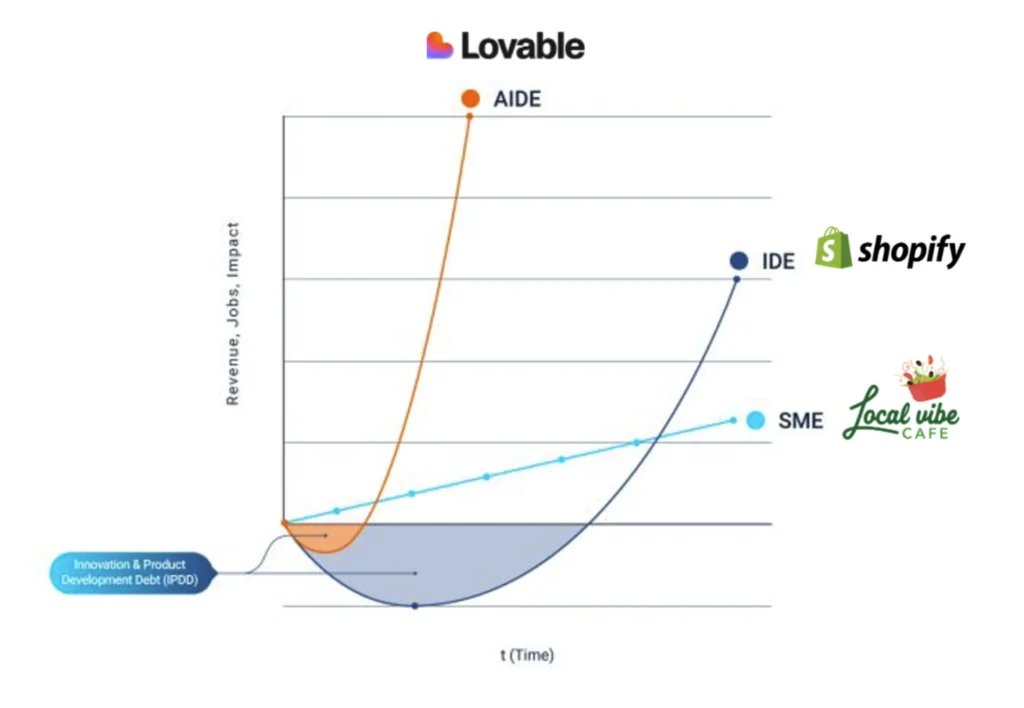
IDE start-up enterprise founders begin with a strong aspiration to grow and have a high valued “exit”. IDEs have historically had large and expensive Innovation and Product Development Debts (IPDDs) and high headcount requirements that require angel/VC funding and multiple funding rounds to develop product and capture market share, as well as long and uncertain paths to profitability. Shopify is an example of an IDE.
A new force is rewriting this traditional model. Artificial Intelligence (AI) is dismantling the great barriers that once gated progress. Its effect is not small, but exponential. AI is no longer a side tool but a core driver of value. It compresses timelines, de-risks science, and slashes capital needs. This change requires a new strategic model— what Paul Cheek has dubbed the AI-Driven Enterprise (AIDE). These AIDEs:
- Drastically reduce IPDD
- Allow rapid iteration and market entry
- Achieve high revenue with minimal headcount
For instance, Lovable.dev rapidly scaled its revenue to $17M ARR in just three months with a lean team of 15 employees by integrating AI extensively into its product development and operations. This ultra-lean approach demonstrates the transformative potential AI holds, a potential traditionally inaccessible to SMEs.
But not all IDEs are the same. Some ventures are more than just businesses; they are missions. These deep tech, medtech, and pharma companies take on humanity’s greatest challenges. They work to cure diseases, create sustainable materials, capture and sequester carbon, and build new computational tools. Their success is measured in human progress, not just financial returns. Yet, these companies face the hardest path in the entrepreneurial world. They require immense capital, accept huge risks, and operate on decade-long timelines. Everything takes longer, is more expensive, is riskier, and requires higher capital requirements as we move from Digital IDEs like Shopify to Deep Tech IDEs, Medtech IDEs, and Pharma IDEs.
The application of AI within deep tech, medtech, and pharma startups has the potential to drive a dramatic shift in societal progress. This approach can accelerate the future by launching a greater number of world-changing innovations. Much like the AIDE model shortens timelines, reduces IPDD and resource needs, and increases potential impact for IDEs, those deep tech, medtech, and pharma companies that have longer time to market can also apply the AIDE model to have a similar effect, albeit at a different scale.

The Highest Stakes: The Promise and Challenge of World-Changing Ventures…..