

By Paul Cheek, Senior Advisor, Entrepreneurship & AI, Martin Trust Center for MIT Entrepreneurship and Jeff Larsen, Assistant Vice-President, Innovation and Entrepreneurship, Dalhousie University
Why it Matters
Creating the next wave of high growth startups
Traditionally, Innovation-Driven Enterprises (IDEs) have been the primary vehicles for scaling transformative technologies. These firms, like Shopify, require significant capital, long innovation cycles, and large teams to bring breakthrough products to global markets – but they have delivered outsized impact as far as jobs and economic impact. On the other hand, Small and Medium-sized Enterprises (SMEs)—local businesses like restaurants or small retailers—typically operate with modest resources and innovate incrementally.
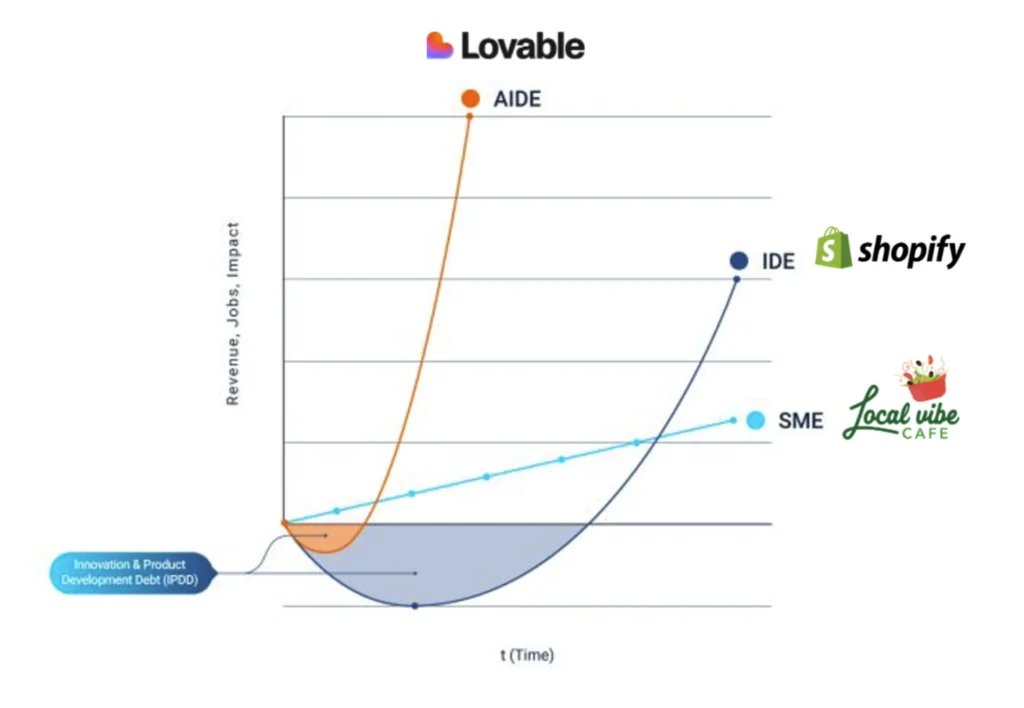
While IDEs aim for exponential growth, SMEs generally grow linearly. However, a new entrepreneurial model is emerging with AI at its core which can blend the innovation capacity of IDEs with the efficiency and agility of SMEs. In a recent article, MIT’s Paul Cheek has dubbed these ventures: AI-Driven Enterprises (AIDEs) explained that the emergence of rapidly scaling AIDEs – where a handful of people with AI can create enormous value quickly – is reshaping assumptions about what it takes to build a successful company. AIDEs leverage artificial intelligence at their core to drive all aspects of their businesses including market research, product development, go-to-market, administrative functions such as finance and HR, and overall operations. AIDEs combine the global ambition and innovative edge of IDEs with a lean operational footprint more akin to SMEs; reducing risk and increasing the likelihood of success along the way.
The AIDE Model
Cheek explains that AIDEs leverage artificial intelligence at the core of their operations—integrating AI into product development, market research, finance, HR, and other administrative tasks. This ssignificantly lowers innovation product development debt (IPDD)—the time and cost it takes to transform ideas into market-ready products. As a result, AIDEs can launch products more quickly, using fewer resources and smaller teams. For instance, while companies like LinkedIn and Shopify needed 600–900 employees to reach $100 million in annual recurring revenue (ARR), newer AIDEs such as Anysphere and ElevenLabs have hit the same milestone with under 50 employees.
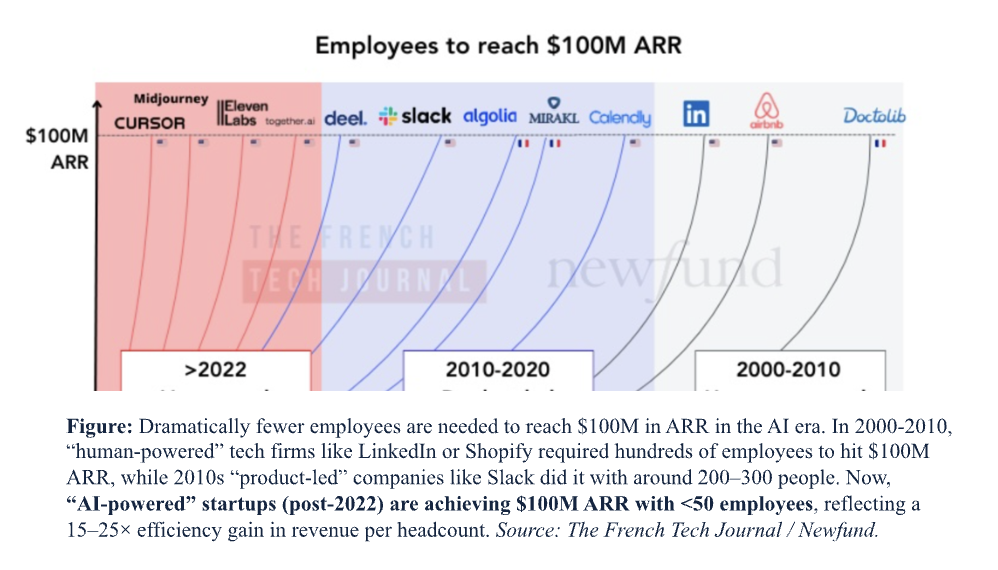
This shift has given rise to a new generation of startups generating substantial revenue with minimal staff. The traditional steep growth trajectory—demanding large upfront investments and sizable teams—has flattened; revenue arrives earlier and scales more rapidly, reducing the need for extensive funding or headcount in the early stages. Essentially, AIDEs blend the global scale and innovation of IDEs with the lean, agile structure typical of SMEs.
AIDEs: Accelerating Growth with Capital Efficiency….. READ THE FULL ARTICLE HERE.